

You might have tried everything from reward charts to reading logs to negotiations at bedtime yet your child still sees reading as a chore, something to avoid rather than enjoy. Luckily for you, you’re not alone in this. Recent data shows that a large number of children age read frequently for pleasure, but reading enjoyment drops dramatically as kids get older. The good news is that the problem isn’t always your child’s ability to read. Sometimes it is all about finding the right book at the right time.
Is my child a reluctant reader or a struggling reader?
Before talking about choosing books, it’s important to understand what you’re working with. The distinction between reluctant readers and struggling readers matters because they need different kinds of support.
Struggling readers face genuine challenges with decoding words, reading fluency, or comprehension. They need structured literacy intervention and may benefit from working with a reading specialist or tutor who can build foundational skills. Reluctant readers, on the other hand, can read but they just don’t want to. They haven’t found material that speaks to them yet.
Many children fall into both categories, creating a cycle where difficulty breeds avoidance, which deepens the gap further. However if your child can read at or near grade level but simply won’t pick up a book, you might be dealing primarily with motivation, and motivation can be sparked by something as simple as the right book landing in your child’s hands.
Why won’t my child just read what I give them?
Decades of reading research tells us that choice is the most powerful reading motivator that exists. When children get to choose what they read, their comprehension improves, their reading time increases, and their attitudes toward reading become more positive.
Think about your own reading life for a moment. You choose books based on your interests, your mood, and what sounds appealing in that moment. No one tells you that a book is “too easy” or judges your choice of a thriller over literary fiction. Yet we often do exactly that with kids. We push books we think they should read instead of books they actually want to read.
Studies show that autonomy in book selection creates lasting engagement, while external rewards like prizes or reading competitions actually decrease intrinsic motivation over time. Your child needs the power to choose, even if their choices surprise you. That said, choice works best when paired with guidance, which is where you come in.
How do I know which books are right for my child’s reading level?
Once you understand that motivation matters most, the next question becomes practical. How do you choose the right books to encourage a reluctant reader? Finding books at the right difficulty level is part of the equation, but it’s easier than you might think.
The goal is what literacy experts call the “sweet spot.” Here, your child can read independently without frustration but still encounters enough new vocabulary to grow. For younger children, try the Five Finger Rule. Have them read one page aloud, raising a finger for each word they don’t know. Two to three unknown words per page is perfect. Zero to one means the book might be too easy (though reading “easy” books builds confidence and fluency). Four or more suggests the book should wait.
For older students, reading level tools can help narrow your search. The Lexile Framework assigns numbers to both readers and books, making matching more precise. Free apps like Level It Books let you scan any book’s barcode to instantly see its reading level. Your child’s school can provide their current reading level, or your local librarian can help assess it informally.
Reading level shouldn’t be a rigid boundary. If your child is deeply interested in a topic, they’ll often tackle more challenging text than their measured level suggests. Vice versa, reading below level can be a confidence booster that reignites reading motivation.
What if my child only wants to read graphic novels or comics?
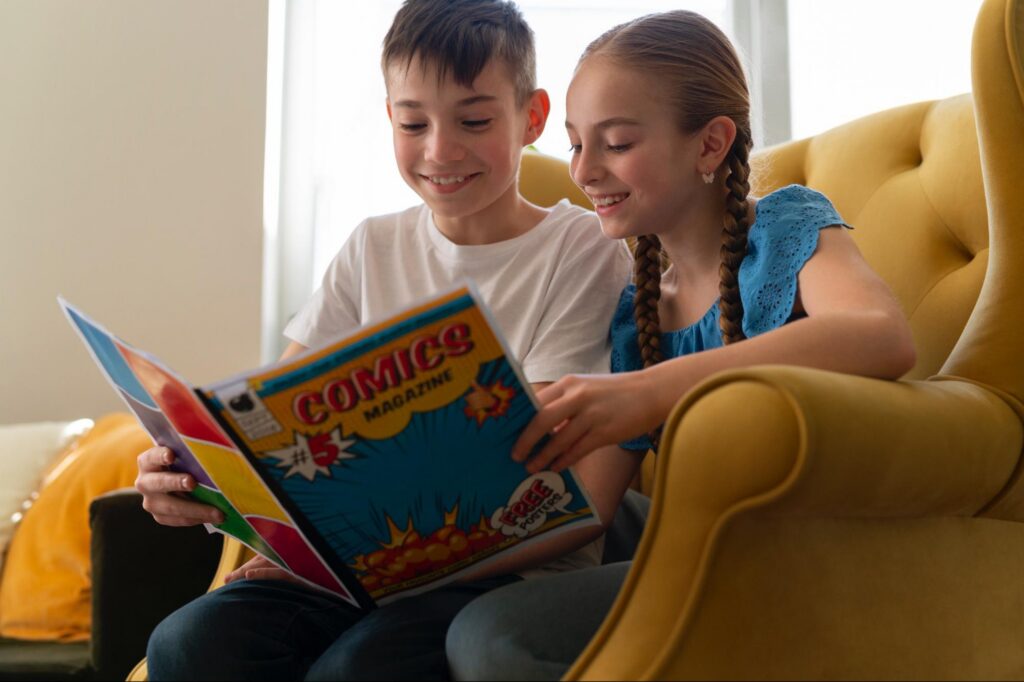
This brings us to one of the most common concerns parents raise. You might worry that if you let your child read graphic novels, comics, or magazines, they’re not doing “real” reading. This concern is understandable, but the research is crystal clear: these formats are absolutely real reading.
In fact, studies show that graphic novels contain an average of 53.5 complex or rare words per 1,000 words, often higher than traditional chapter books. Sixth-graders reading graphic novels score higher on comprehension tests than peers reading standard text. The visual component is a legitimate literacy tool. When students can use images alongside text to understand vocabulary and context, they’re practicing reading comprehension skills.
Series like Dog Man, Smile, New Kid (the first graphic novel to win the prestigious Newbery Medal), and Amulet have launched countless reluctant readers into confident reading habits. The same principle applies to audiobooks, magazines, and even choose-your-own-adventure books. Author Neil Gaiman put it best: there is no such thing as a bad book for children. The book that hooks your child might not be the one you would have chosen, and that’s exactly as it should be. Once a child experiences the joy of being absorbed in a story (regardless of format) they’re far more likely to branch out to other types of reading.
How do I choose the right books to encourage a reluctant reader?
Start with a real conversation about your child’s interests. What YouTube channels do they watch? What games do they play? What makes them laugh? These interests are direct pathways to books they’ll actually read. Once you know what sparks their curiosity, you can look for books that connect to those passions.
While you’re browsing to match their interests, think about structure and pacing. Reluctant readers respond well to books with short chapters that feel accomplishable, humor that makes reading fun instead of feeling like work, and fast-moving plots that don’t bog down in description. If your child connects with one book, look for others in the same series in order to nudge familiarity.
Your local librarian can be your best resource, matching children with books based on both interests and reading level. Online tools like the Lexile Find a Book tool and Common Sense Media’s reluctant reader collection also make searching easier when you’re browsing from home. Additionally, don’t underestimate the power of peer recommendations. You can always ask your child’s friends what they’re reading. For older kids and teens especially, a suggestion from a friend often carries more weight than anything an adult recommends.
Could my child benefit from personalized reading support?
Sometimes, despite your best efforts with creating a reading-friendly environment, reluctant reading might persist and it could even signal something deeper. Your child might be struggling with comprehension skills they’re working hard to hide. They might have undiagnosed learning differences that make reading difficult even when they seem to decode words adequately. Sometimes they might simply need someone outside the parent-child dynamic to help rebuild their confidence without the emotional weight that sometimes comes with parent-led learning.
This is where personalized, one-to-one academic support can make all the difference. At Tutor Doctor, we’ve helped numerous families navigate this challenge. Our tutors help students discover what reading can feel like when the right book lands in the right hands at the right time. We also match students with tutors based on personality and learning style because we know that a genuine connection makes all the difference. Contact Tutor Doctor today to learn how we can support your family’s goals.