
Most students read the same paragraph three times and still can’t explain what it said. The best reading comprehension strategies don’t just help kids get through text faster; they change how much of it actually sticks, and how long it stays there. If you’ve ever sat beside your child during homework and watched them stare blankly at a page they’ve already “read,” this is the guide that explains what to do using research-backed reading comprehension strategies.
Active Questioning: Ask Before, During, and After Reading
Before your child reads a single word, have them ask what they already know about the topic and what they expect to learn. During reading, prompt them to pause at the end of each section and ask, “What was the main point?” After finishing, ask them to tell you what they remember without looking back. This three-phase approach forces the brain to treat text as something to engage with, not just scan.
Try asking before homework: “What do you think this chapter is going to be about?” It sounds simple, but it gives your child a purpose for reading, and purposeless reading is where comprehension quietly falls apart. Students who skip the “before” phase often can’t summarize what they just read because they never set out to understand it in the first place, and if your child resists sitting down with a book at all, it helps to start by finding books they actually want to read.
The SQ3R Framework: Survey, Question, Read, Recite, Review
SQ3R is a structured reading strategy that gives your child a clear process to follow before, during, and after reading rather than simply working through a text from beginning to end. Here’s how each step translates from classroom theory into something you can actually coach at home.
Survey
Before reading, skim headings, subheadings, bolded terms, and the first sentence of each paragraph. Your child is building a mental map before committing to the details. Where kids go wrong: they survey too quickly and skip visual elements like captions and pull quotes, which often carry the passage’s core ideas.
Question
Turn every heading into a question. “The Water Cycle” becomes “How does the water cycle work?” This primes the brain to hunt for answers rather than passively absorb words. Prompt your child: “Can you turn that heading into a question?” The failure here is writing questions so vague they match anything; “What is this about?” gives the brain nothing useful to search for.
Read
Now read actively with those questions in mind, slowing down at dense passages instead of pushing through. Rushing this step is where the whole framework falls apart for most students. If your child is flying through pages in two minutes, they’re probably not reading; they’re scanning and hoping.
Recite
After each section, close the book and say or write the answer in their own words. This step helps reveal what your child can explain from memory and where they may need another look. If they struggle to put the section into their own words, go back together and identify what wasn’t clear.
Prompt: “Close the book and tell me what that section was about.”
Review
Go back and check how well those recitations matched the text, then correct what was missed. This step takes two minutes, and most students skip it entirely, which means they never find out what they got wrong before the test does.
Retrieval Practice and Brain Dumping for Deep Retention
After reading a chapter or article, have your child close it and write down everything they remember without looking back. This type of retrieval practice is supported by a substantial body of learning research and can help strengthen long-term retention.
Struggling to remember everything immediately doesn’t mean the strategy has failed. The attempt to retrieve information is part of the practice, and checking what was missed afterward gives your child a clearer picture of what they know and what still needs review.
As a parent, you can make this a two-minute dinner table habit, and for more ways to reinforce these skills at home, explore these reading comprehension activities for kids. “Tell me three things you learned in reading today” is retrieval practice. It doesn’t need to be formal to work.
Metacognitive Monitoring: Teaching Kids to Notice When They’re Lost
Metacognition means tracking your own understanding while you read. For kids, the practical version looks like this: when they hit a sentence that doesn’t land, they notice it and stop, rather than moving on and hoping it resolves itself three pages later.
One challenge is that students don’t always notice right away when they’ve lost the thread. A simple strategy you can try at home is having your child rate their understanding from 1-3 at the end of a paragraph or section. If they rate it a 1, have them pause, return to the section heading, and re-read the part that was unclear. Over time, this can help them get better at noticing when they need to slow down or ask for help.
Concept Mapping to Visualize Complex Material

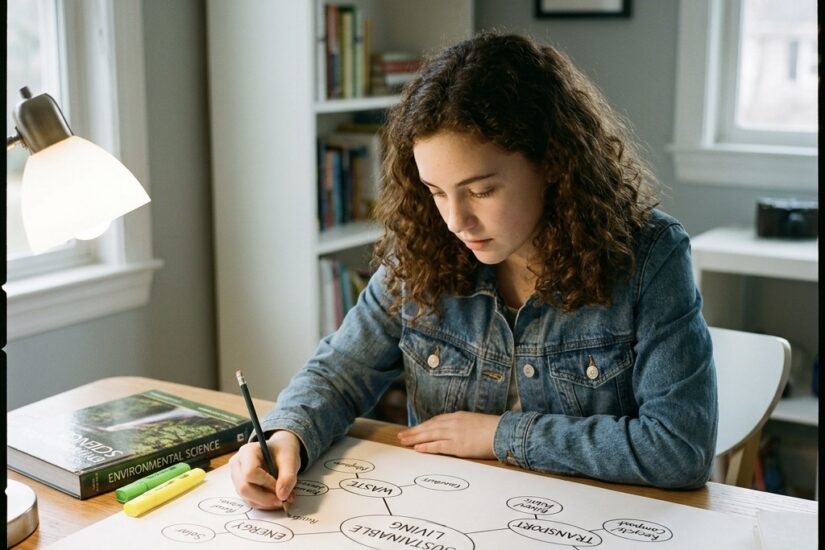
Put the central idea in the middle of a blank page and connect related ideas, supporting details, and examples outward from it.
For students working through dense science chapters or history passages, where the relationships between ideas matter as much as the ideas themselves, this is often the clearest way to see whether they actually understood the structure of an argument or just memorized its parts.
The biggest mistake kids make is turning concept maps into outlines with boxes around them. The connections between nodes are where the understanding lives, so encourage your child to label every line with a verb or relationship: “causes,” “supports,” “depends on.” Unlabeled lines are just decoration on a page. If your child can label those connections, they understand the material. If they can’t, that’s useful information before the test rather than during it.
Spaced Repetition and Flashcards for Long-Term Memory
Spaced repetition means returning to material across multiple study sessions rather than reviewing it all at once. The exact timing can vary, but gradually spacing reviews gives your child repeated opportunities to retrieve information and strengthen it over time. This can be particularly useful when preparing for exams that require students to retain material over a longer period.
The catch most students miss is that flashcards only work for comprehension if the cards test understanding, instead of isolated facts. “What does osmosis mean?” is a weak card. “Why does osmosis matter in a cell under high salt conditions?” is a strong one; it forces application of the relevant information. Weak cards give students the feeling of studying without the results. When you’re helping your child make flashcards, push them toward application questions: “Can you write a question a teacher might actually ask?”
Writing flashcard questions the way a professor would ask them on an exam produces far better retention than copying definitions word-for-word from a textbook.
The 90-Second Rule for Difficult Passages
When your child hits a passage they genuinely don’t understand, give them 90 seconds to work through it before moving on. Read it again slowly. Try rephrasing it in plain language. Break it into individual sentences and ask what each one is claiming.
Skipping confusing passages is one of the most self-sabotaging habits in otherwise diligent students. They assume the meaning will become clear from context, and it usually doesn’t. Moving on without understanding a key passage is like driving on a flat tire because you’re already late; you’ll get somewhere, but not where you needed to go.
The goal is never to fake your way past confusion. If it keeps happening across subjects, it may be worth getting in touch with a tutor who can pinpoint exactly where the gaps are.
Don’t Rely on Re-Reading Alone
Re-reading can be useful when your child needs another look at a difficult passage, but it shouldn’t be the only strategy they use. Simply reading the same material repeatedly can create a feeling of familiarity without showing whether your child can actually recall or explain what they’ve learned.
After re-reading something that wasn’t clear, have your child close the material and explain the main idea in their own words. The next time they say, “I already read it,” a useful follow-up is: “Okay, close the book and tell me what it said.”
The strategies that stick share one thing: they all require your child to do something with the text, not just look at it. If you’re not sure where to start, retrieval practice is a useful entry point: close the book and try to reconstruct the key ideas before checking. It gives your child a way to see what they can actually recall rather than relying on familiarity with the text. And if your child needs more structured support than homework coaching can provide, find yourself a local English tutor from Tutor Doctor who can build these habits one-to-one, at exactly the pace your child needs.
Frequently Asked Questions
How can I improve my reading comprehension skills?
Start by reading with a specific purpose; know what you’re looking for before your eyes hit the first line. Then practice summarizing each section in one or two sentences without looking back at the text, which forces your brain to consolidate what it just processed. Do that consistently across different types of material and your comprehension will improve faster than any single trick will get you there.
What is the SQ3R method for reading comprehension?
SQ3R stands for Survey, Question, Read, Recite, and Review, a structured five-step approach that turns passive reading into an active process. You start by skimming the text for structure and key headings, then convert those headings into questions you read to answer. It takes a bit longer upfront, but the recall it produces is substantially better than a straight read-through.
What should I do before, during, and after reading to improve comprehension?
Before reading, preview headings, subheadings, and any visuals to build a mental framework for what’s coming. During reading, annotate, ask questions, and pause periodically to check whether you could explain what you just read. After reading, summarize the main ideas from memory and connect them to something you already know.
What are proven techniques for reading faster while understanding more?
It depends on what’s slowing you down: subvocalization, regression, or simply unfamiliar vocabulary. Reducing how often your eyes jump back to re-read lines and chunking groups of words together rather than reading word-by-word are two of the more practical speed gains backed by reading research. That said, for dense or technical material, slowing down and using a structured strategy like SQ3R will serve your comprehension better than any speed-reading shortcut.