Your child can read every word on the page and still miss what the page is actually about. That gap between decoding and understanding is one of the most common reading struggles parents run into, and it shows up at every age, from a six-year-old who can sound out “castle” but can’t tell you why the character built one, to a fourteen-year-old who finishes a chapter and has no idea what just happened in it.
The good news is that reading comprehension involves skills and habits that can be strengthened with instruction and practice. You do not need a stack of worksheets to support comprehension at home. Simple, repeatable activities can reinforce the strategies your child is learning and help you notice where additional support may be needed.
Here are four activities you can start using this week, with guidance on how to adjust each one for younger and older readers.
| Activity | Builds | Best for |
| Story Maps | Structure and sequencing | Fiction, chapter books |
| Retelling | Summarizing and recall | Any reading, daily use |
| Question the Author | Critical thinking | Nonfiction, persuasive texts |
| Paired Reading | Confidence with harder texts | Reluctant or stretch readers |
1. Story Maps
A story map is a visual breakdown of a book or chapter: characters, setting, problem, key events, and resolution. It gives your child a structure to hang the story on, which is especially useful for kids who read the words fine but struggle to organize what happens into a coherent whole.
- For younger readers (6–9): keep it simple. A basic template with boxes for “Who,” “Where,” “Problem,” and “How it was solved” works well. Let your child draw pictures instead of writing if that’s easier for them; the goal is to get them thinking about story structure, not to produce a polished worksheet.
- For your teen (10–14): add complexity. Include a section for rising action, a plot arc line, or a spot to track how a character changes from the beginning of the book to the end. This version starts to mirror the kind of story analysis your teen will be asked to do in middle school English class, which makes it useful prep as much as it is a comprehension tool.
You can make this a five-minute conversation after each reading session rather than a formal written exercise. The habit of pausing to ask “who, where, what problem, what happened” matters more than the format.
2. Retelling
It sounds simple, but retelling is a useful way to check what your child understood and remembered. Difficulty retelling may reveal a comprehension gap, although it can also reflect challenges with memory, language, or organizing ideas.
- For younger readers: start small. After a picture book or a single chapter, ask your child to tell you what happened in three or four sentences. Resist the urge to fill in gaps for them right away. If they get stuck or start rambling, that’s useful information: it tells you where the understanding broke down.
- For your teen: push retelling toward summarizing rather than recounting. A summary picks out the main events and leaves out the minor details, which is a harder skill than it sounds. You can prompt this by asking, “If you only had one minute to tell a friend what this chapter was about, what would you say?”
Retelling also works well in the car, at the dinner table, or during a walk. It doesn’t require materials, which makes it one of the easiest comprehension activities to fit into an already busy week.
3. Question the Author
Instead of treating every sentence as automatically clear, encourage your child to question what the author is trying to say and how well the text communicates it. Prompts such as “What does the author mean here?” or “Did the author explain that clearly?” help readers pause, revisit the text, and actively build meaning.
- For younger kids: keep the questions concrete: “Why do you think the author gave the dog that name?” or “Why did the author put a picture here?”
- For your teen: move into more analytical territory: “Why did the author choose to reveal this detail now instead of earlier?” or “What is the author trying to convince me of in this paragraph?”
This works particularly well with nonfiction and persuasive texts, where noticing the author’s intent is a big part of understanding the piece.
4. Paired Reading

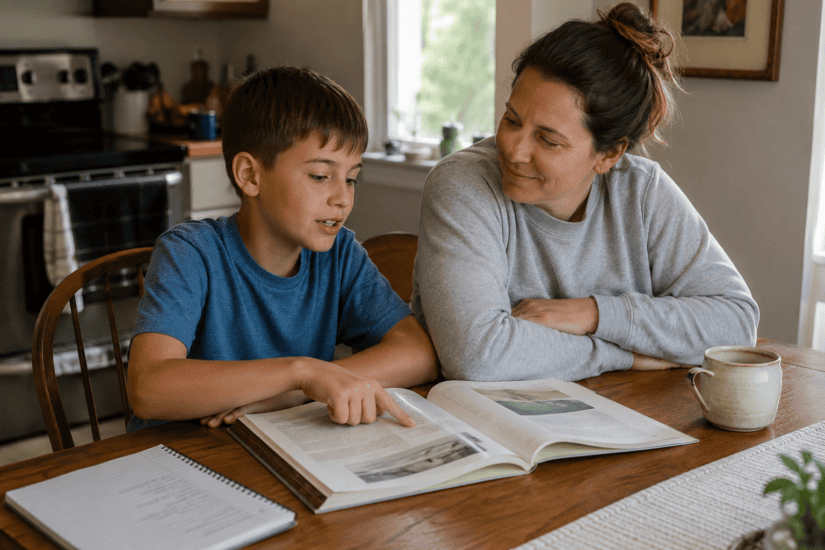
Paired reading means reading the same passage together, either alternating sentences, paragraphs, or pages, or having your child read aloud while you occasionally pause to ask a quick question or offer a word they’re stuck on.
- For early or reluctant readers: paired reading takes the pressure off. Your child isn’t carrying the whole passage alone, which frees up mental space to actually think about meaning instead of just getting through the words.
- For your teen: paired reading works well with denser or more challenging material, like a required school text they find dry or difficult. Reading a section together and stopping to talk through a confusing passage models the kind of active reading that strong comprehension depends on: pausing, questioning, connecting new information to what came before.
You don’t need to do this with every book. Save it for material that’s a genuine stretch, whether that’s due to vocabulary, subject matter, or length.
Building These Into a Routine
None of these activities need to take long, and they don’t need to happen every single day. What matters more is consistency:
- A story map after finishing a book
- A two-minute retell after a chapter
- One “question the author” prompt during a nonfiction unit
Small, repeated practice builds comprehension skills the same way regular practice builds any other skill, and it pays off well beyond reading class. If you’re curious about why this particular skill has such a wide reach, our post on why reading matters for children and teens digs into the connection.
When to Bring in Extra Support
If your child is putting in the reading time but comprehension still isn’t clicking, that’s often a sign they’d benefit from more targeted, one-to-one support. A tutor with Tutor Doctor can look at patterns in your child’s reading, such as difficulties with vocabulary, fluency, recall, identifying main ideas or making inferences, and build targeted support around the skills that need strengthening. Our reading tutors work directly on comprehension alongside decoding and fluency, and our X-Skills™ approach strengthens the underlying study and thinking skills that make comprehension easier across every subject, not just reading.
If you’re not sure exactly where things are breaking down, a learning assessment is a good starting point before committing to a plan.
Explore our elementary and middle school tutoring options, or book a consultation to talk through where your child stands and what a personalized plan could look like. With our Tutor Fit Guarantee, we’ll adjust the plan or the tutor match if it’s not the right fit.
FAQ
What age should reading comprehension activities start?
As soon as a child is reading independently or being read to, usually around age five or six. Comprehension work at this age is often verbal, like asking a child to retell a picture book, rather than written.
How often should we practice reading comprehension activities?
Brief, regular practice is generally more useful than an occasional long session. The right frequency depends on your child’s age, attention span and level of difficulty, but even a short discussion after reading can help reinforce the habit.
My teen reads fine but can’t answer questions about what they read. Is that a comprehension problem?
It can be. Strong decoding skills don’t guarantee strong comprehension, and the gap often becomes more noticeable in middle school as texts get denser. Activities like question-the-author and summarizing can help pinpoint where the disconnect is happening.
Should these activities replace assigned school reading?
No. They work best alongside school reading, applied to whatever your child or teen is already reading, whether that’s an assigned novel, a nonfiction article, or a book they picked for fun.