

When your child’s SAT score report arrives, the numbers can feel more confusing than helpful. You’re proud of their hard work, but you’re also left with questions. What does a 93rd percentile rank actually mean for their dream school? How can you tell if that score opens the right doors, or if they should consider a retake?
If you’re trying to understand what these percentiles mean for your child’s college journey, you’re not alone. Even with the rise of test-optional policies, SAT scores are still an important factor in college admissions. Decoding an SAT score is about understanding where your child stands nationally, what opportunities that creates, and how you can help them move forward with confidence.
What SAT Percentiles Tell You
Your child’s SAT percentile shows the percentage of students who scored equal to or better than. If they are in the 75th percentile, they performed as well as or better than 75% of all students who took the test. This provides crucial context that a raw score alone cannot. Colleges use percentiles to quickly gauge how competitive an applicant is within the national pool of nearly two million test-takers.
On the score report, you will see two types of percentiles:
Nationally Representative Percentile
This compares your child’s score to a sample of all U.S. 11th and 12th-graders, including those who did not take the SAT.
SAT User Percentile
This compares your child’s score against the scores of recent high school graduates who actually took the SAT.
Colleges typically focus on the SAT user percentile, as it reflects a student’s standing among their direct peers in the college admission process.
What Is a Good SAT Score?
While the national average SAT score is around 1030, a truly “good” score is one that aligns with your child’s specific college ambitions. What is excellent for a state university may be below the average for a highly selective institution. Often, the first step is deciding whether the SAT or ACT is the best test for your student’s strengths.
A good score is a tool that helps your child present their best self to the colleges on their list. For many public universities, scores in the 1100–1200 range (around the 65th to 76th percentile) show solid college readiness. For more selective universities, applicants often need scores in the 1300–1400 range (86th to 93rd percentile) to be competitive. The most elite institutions typically see admitted students with scores of 1450 or higher (96th percentile and above).
A truly “good” SAT score is the one that fits your child’s goals, not just an abstract national ranking.
SAT Scores and National Percentile Rankings
Understanding where a specific score falls can help you and your child build a balanced and realistic college list. You may notice that a small score improvement in the middle ranges can lead to a significant jump in percentile rank.
An improvement from 1100 to 1250 can move a student from the 63rd to the 82nd percentile—a leap that dramatically expands their college options. Learn more about how to help your child prepare for the SAT.
This table breaks down recent SAT user percentiles to show where your child’s score places them nationally.
| SAT Score Range | User Percentile | What It Means for Your Child |
| 1510–1600 | 99th+ | Top 1% of all test-takers. Highly competitive for all universities. |
| 1400–1500 | 93rd–98th | Top 7% of test-takers. A strong score for selective universities. |
| 1300–1390 | 86th–92nd | Top 14% of test-takers. Competitive for many selective and flagship state universities. |
| 1200–1290 | 76th–85th | Top 24% of test-takers. An above-average score that is competitive for many quality universities. |
| 1100–1190 | 63rd–75th | Above the national average. Demonstrates readiness for a wide range of colleges. |
| 1000–1090 | 45th–62nd | Around the national average. Meets the benchmark for many public universities. |
Percentiles are based on the latest available data from the College Board and may shift slightly year to year.
How Section Scores Affect Percentiles
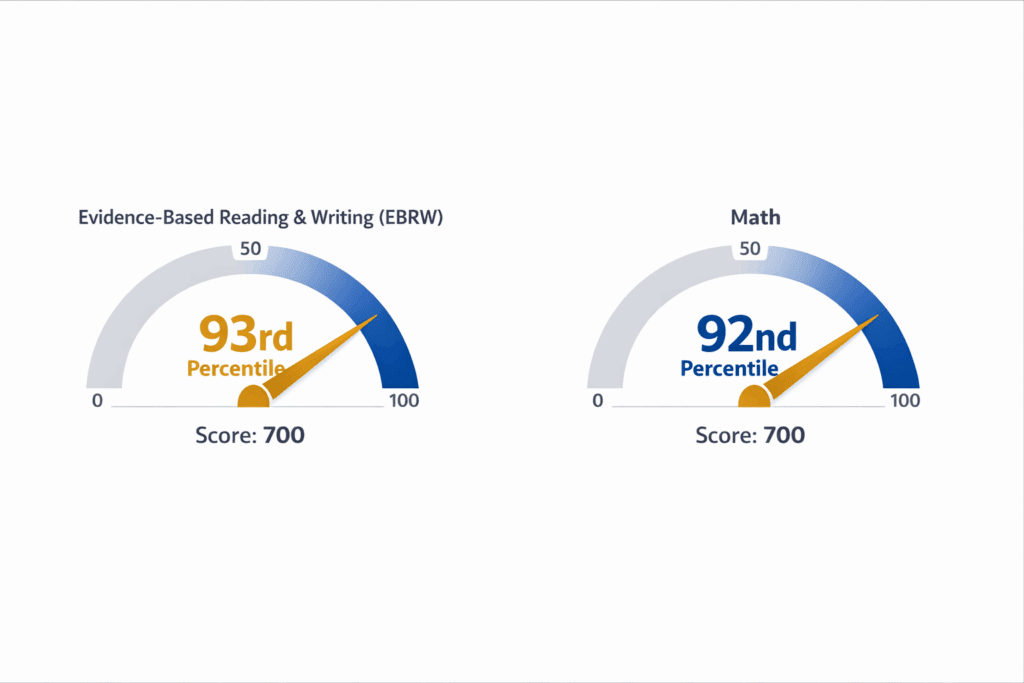
Colleges review both the composite score and the individual section scores for Evidence-Based Reading and Writing (EBRW) and Math. Interestingly, the Math section is slightly more competitive, meaning a student needs a higher score to achieve the same percentile as in the EBRW section.
For example, a 700 in EBRW places a student in the 93rd percentile, while a 700 in Math corresponds to the 92nd percentile. Understanding and correcting common math mistakes can be a quick way to boost this section score and the overall composite.
SAT Score Expectations for Different Colleges
Different types of colleges have different score expectations for their admitted students. While a holistic review means scores are just one part of the application, knowing these benchmarks can help you determine whether to submit scores to a test-optional school.
For test-optional schools, a good rule of thumb is to submit scores only when they fall at or above the college’s published 50th percentile range for admitted students.
| College Tier | Typical SAT Score Range (Middle 50%) | Typical User Percentile |
| Most Selective (e.g., Ivy League, MIT, Stanford) | 1480–1580 | 97th–99th+ |
| Highly Selective (e.g., Duke, Northwestern, Vanderbilt) | 1450–1560 | 94th–99th |
| Selective (e.g., Boston University, NYU, U of Michigan) | 1350–1500 | 90th–97th |
| Strong State Flagships (e.g., U of Florida, Georgia Tech) | 1300–1470 | 86th–96th |
How to Help Your Child Improve Their Percentile

If your child’s current score doesn’t yet match their college goals, a strategic approach to test prep can make a significant difference. The key is to focus on methods that address their unique needs.
Start with a full-length diagnostic practice test to establish a baseline and identify specific areas for improvement, especially with the test’s current format. From there, your child can focus on high-impact topics. For example, creating a positive study environment at home can make prep time more effective. Timed practice is also essential, as it builds the stamina and pacing needed to perform well under pressure. Finally, encourage your child to review every mistake, as each error reveals a pattern that can be corrected before the official test.
Generic prep courses teach to the middle. The benefits of one-to-one tutoring come from addressing a student’s specific challenges and learning style.
When your child’s goals require moving up the percentile rankings, personalized support often makes the difference. At Tutor Doctor, we specialize in helping students raise their percentile ranks because we understand why a tutor is so crucial for SAT prep. Tutors with our service don’t just drill practice questions; they help your child understand their own thinking patterns, develop personalized strategies, and approach test day feeling capable and calm.
Not sure if your child needs that extra help? Review these 10 signs it might be time to find a tutor. We match your child with an expert who understands how they learn best, adapting every session to ensure they are making real, measurable progress.