

“Should my child focus on the SAT or the ACT? Her friend got a 29, but she has a 1350 SAT, which is better? And what does her PSAT score mean for the real test?”
If you’re asking questions like these, you’re not alone. Navigating the world of standardized testing can feel overwhelming, especially when you’re trying to make sense of scores and help your child prepare for college applications.
We understand. Behind every test score is a capable student with unique strengths. While the numbers are important, understanding what they mean and how important scores are today matters even more. With the right information and support, you can turn anxiety into a clear, confident plan.
Understanding the SAT and ACT Conversion Chart
An SAT to ACT conversion chart, officially known as a concordance table, is a tool that helps you compare scores between the two tests. Think of it as a translation guide where a 1300 on the SAT represents a similar level of college readiness as a 28 on the ACT.
This is valuable because it helps you and your child make informed decisions. You can use it to determine which test might better suit their strengths, decide which score to submit if they’ve taken both, and set realistic goals based on a baseline score from a practice test or the PSAT.
These tables show comparable performance, not an exact equivalence. The goal is to understand which score better represents your child’s abilities, not to get a perfect score-for-score match.
These tables, created jointly by the College Board and ACT, remain the official standard used by colleges and scholarship programs today.
Official SAT to ACT Concordance Table
This table shows how composite SAT scores (out of 1600) correspond to composite ACT scores (out of 36).
| SAT Score | ACT Score | SAT Score | ACT Score | SAT Score | ACT Score |
| 1600-1570 | 36 | 1320-1300 | 28 | 1020-990 | 19 |
| 1560-1530 | 35 | 1290-1260 | 27 | 980-960 | 18 |
| 1520-1490 | 34 | 1250-1230 | 26 | 950-920 | 17 |
| 1480-1450 | 33 | 1220-1200 | 25 | 910-880 | 16 |
| 1440-1420 | 32 | 1190-1160 | 24 | 870-830 | 15 |
| 1410-1390 | 31 | 1150-1130 | 23 | 820-780 | 14 |
| 1380-1360 | 30 | 1120-1100 | 22 | 770-730 | 13 |
| 1350-1330 | 29 | 1090-1060 | 21 | 720-690 | 12 |
| 1050-1030 | 20 | 680-650 | 11 |
Common Score Conversion Questions Answered
Parents often ask us how to interpret specific scores. Here are some of the most common questions we hear.
What is a 1350 SAT on the ACT?
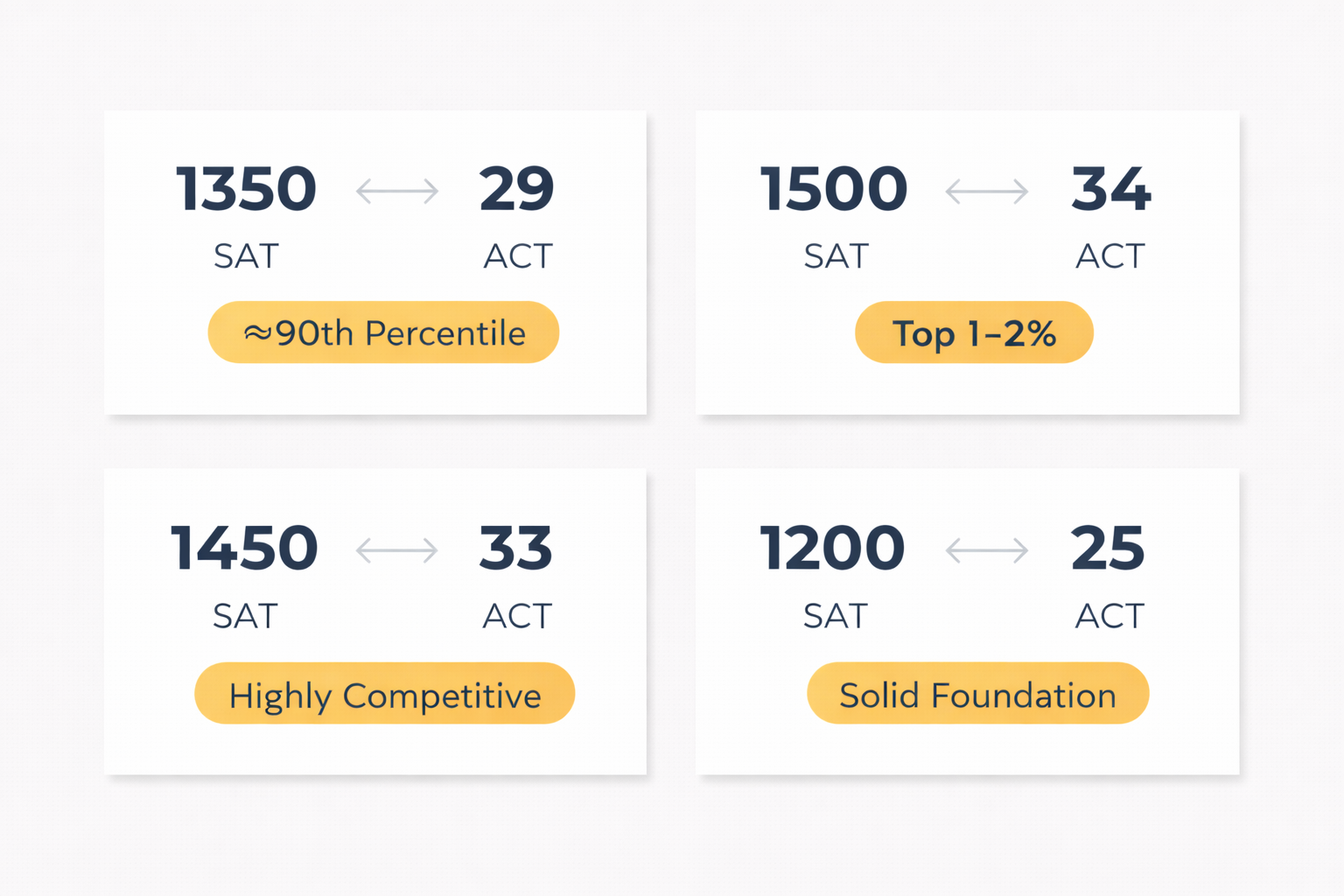
A 1350 SAT score is comparable to a 29 on the ACT. This is a strong score that places your child above the national average and in a competitive range for many selective colleges. Both scores demonstrate solid college readiness and place a student around the 90th percentile. That is an achievement to feel good about.
What does a 1500 SAT equal on the ACT?
A 1500 SAT is equivalent to a 34 on the ACT. This is an excellent score that places your child in the top 1-2% of all students. Whether your child is applying to highly competitive universities or for merit-based scholarships, either of these scores will significantly strengthen their application.
Is a 33 ACT or 1450 SAT better?
According to the concordance table, a 33 on the ACT is comparable to a SAT score in the 1450-1480 range. This means a 33 ACT and a 1450 SAT are essentially equivalent. Neither is definitively “better,” as both are impressive scores. When deciding which to submit, consider the section scores. If one test better highlights your child’s strengths related to their intended major, it may be the more strategic choice.
What is a 1200 SAT on the ACT?
A 1200 SAT converts to a 25 on the ACT. This is a respectable score near the national average that shows your child has a solid foundation for college-level work. The encouraging part is that with focused preparation, students starting from this baseline have great potential to see meaningful improvement.
PSAT to SAT Score Conversion

If your child has taken the PSAT, that score is a valuable baseline for their potential SAT performance. A 600 on the PSAT Math section, for example, indicates that your child is on track to score around 600 on the SAT Math section without further preparation.
Your child’s PSAT score is a starting point, not a final destination. With focused support and effective strategies, significant improvement is achievable.
While the PSAT is a strong indicator, it’s not set in stone. Most students naturally improve their scores between the PSAT and SAT. The PSAT shows your child’s current abilities and helps create a roadmap for where to focus their prep efforts.
Which Test Should Your Child Take?
The best way to decide between the SAT and ACT is to have your child take a full-length, timed practice test of each. Many students find they have a natural preference or perform significantly better on one over the other.
Having your child take a full-length practice test of each is the most reliable way to see which format suits them best. This simple step can save months of preparation by ensuring your child focuses on the right test.
Generally, the SAT may be a better fit for students who excel at deep reading comprehension and enjoy having more time per question. In contrast, the ACT often appeals to students who work quickly and are strong in data interpretation.
The most reassuring truth for parents is that nearly all U.S. colleges accept both scores equally. The decision should be based on your child’s strengths, not on what you think colleges prefer.
Go Beyond the Numbers with Personalized Test Prep
Understanding score conversions is a great first step, but improving performance requires a personalized approach. If your child feels anxious about testing or is struggling to improve, you don’t have to navigate this journey alone.
Our approach focuses on building your child’s confidence right alongside their skills. We begin by understanding your child’s unique needs, using diagnostic tools to identify which test best suits their strengths and pinpointing specific areas for growth. From there, we develop strategies that work with their natural learning style, building confidence through supported practice in a judgment-free environment.
Support That Fits Your Family
We know that life is busy. Our tutors meet your child where they are—whether that’s in your home or online, at times that fit your family’s schedule. This flexibility provides consistent, one-to-one support without adding more stress to your calendar.
This journey also involves the whole family. We keep you informed with regular session reports, help set realistic goals, and provide guidance that extends beyond test prep. We are invested in your child’s overall success and are committed to helping them feel capable and motivated again. If you’re wondering if now is the right time for support, it can help to know the common signs it might be time for a tutor.
Ready to Build Confidence and Improve Scores?
The conversion charts in this guide are useful tools, but they only tell part of the story. Behind every number is a student with unique potential. With the right encouragement and personalized support, your child can achieve scores that open doors to their future.
Find a tutor near you and take the first step toward building both scores and confidence.