
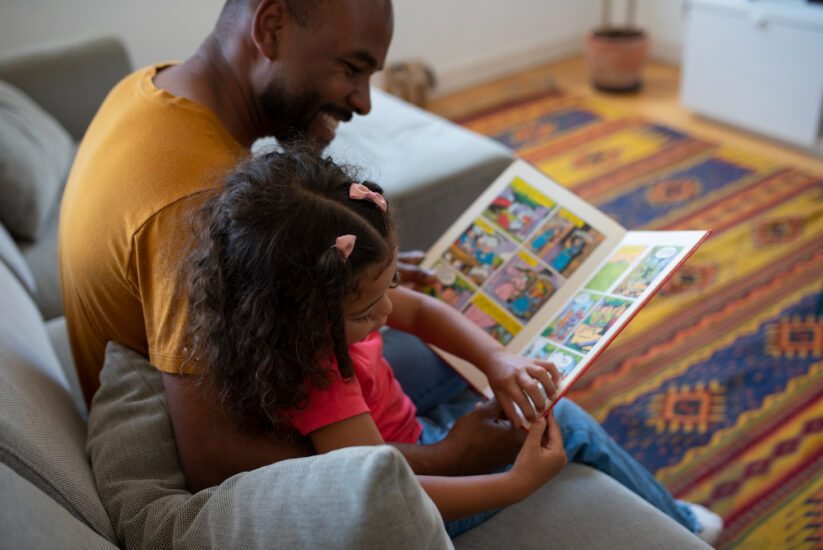
It’s 8:30 p.m., your child is asking for one more story, and you’re feeling completely drained. You pick up the book, do your best voices, and you wonder. Does this nightly routine actually matter?
It does. More than you might think. The simple act of reading a story aloud shapes the way your child learns to think, communicate, and connect with the world. It’s a practice with lasting benefits, and the good news is that it’s never too early, or too late, to start.
The Research Behind Reading Aloud
Researchers have studied the effects of reading aloud for decades, and the findings are remarkably consistent. Children who are read to regularly gain significant cognitive and emotional advantages that support them through school and beyond.
One landmark study on the “million word gap” found that children whose parents read to them daily hear roughly 1.4 million more words by kindergarten than children who are never read to. This early exposure directly shapes their vocabulary, comprehension, and academic performance. It’s why the American Academy of Pediatrics recommends reading aloud from birth. They advise starting in the very first days of life, not waiting until a child can follow a story. Early language exposure helps build a stronger foundation for every stage of learning.
Children who are read to daily hear roughly 1.4 million more words by kindergarten than those who are never read to.
The Lasting Benefits of Reading Aloud
While it’s easy to see reading aloud as a literacy activity, its benefits reach much further.
It builds a strong academic foundation. Reading aloud lays the groundwork for school success. Books introduce words that aren’t common in everyday conversation, naturally building a child’s vocabulary. Hearing you read teaches them to follow a narrative, make predictions, and understand context. These are the same skills that drive reading comprehension, which is essential for success in all subjects. Children who hear well-structured sentences also begin to internalize those patterns, which later show up in their own writing.
It nurtures emotional intelligence and connection. Beyond academics, reading together is a simple yet powerful way to build your relationship. In the safety of your presence, stories allow children to explore complex emotions like fear, friendship, and fairness. This shared time is relationship time, creating a space for closeness and conversation.
It develops focus and expands their world. Following a story from beginning to end requires a child to stay present and engaged, steadily building their focus and attention span. At the same time, books introduce them to new places, people, and ideas they wouldn’t otherwise encounter, giving them background knowledge that is crucial for understanding the world.
It fosters a genuine love of reading. When reading is associated with warmth, closeness, and your voice, children see it as a joy, not a chore. A great book, shared with enthusiasm, can be just as engaging as a screen. It also builds something that lasts.
How Does Reading Aloud Improve Reading Skills?
When you read aloud, you’re giving your child a model of what fluent, expressive reading sounds like. They notice how your voice rises with a question, slows down during a tense moment, and pauses for punctuation. Long before they can decipher words on their own, they are developing an intuitive understanding of how reading and comprehension affects all subjects.
This is especially helpful for children who are still building their own reading skills. Hearing a story read smoothly gives them a goal to aim for. It also gives them access to stories that might be above their current reading level, keeping their curiosity and love of stories alive while their skills continue to develop.
| Stage | How Reading Aloud Helps |
| Infants | Infants absorb the rhythm and sounds of language, associating your voice with warmth and comfort. |
| Toddlers & Preschoolers | Children become more interactive, predicting what happens next and connecting stories to their own lives. |
| Early Readers (Ages 6-8) | Reading aloud models fluency and expression, and it allows them to enjoy more complex stories than they can read on their own. |
| Older Children (Ages 9+) | Continuing to read aloud builds advanced vocabulary, maintains your connection, and keeps reading a shared family activity. |
Starting and Sticking with It

The benefits of reading aloud begin at birth and continue well into the school years. While it’s ideal to start from infancy, the most common mistake is stopping too soon. Many families phase out the practice once a child can read independently, but continuing to read aloud through elementary and even middle school helps build advanced vocabulary, strengthen comprehension, and maintain your connection.
Making reading aloud a consistent habit is the key, and it doesn’t require a huge time commitment. Even fifteen minutes a day makes a significant difference, as consistency matters more than duration. To make it a sustainable part of your routine, try tying it to an existing habit, like reading after dinner or before bed. Turning your home into a positive study environment can also make the routine feel more special.
Remember, you don’t need to put on a perfect performance. Even on tired days, the simple act of reading together is what matters most to your child.
What if My Child Still Resists Reading?
Sometimes a child’s disinterest is simply a sign that they haven’t found the right book yet. However, if your child is engaged when you read aloud but struggles or avoids reading on their own, it may be a sign they need a different kind of support to build their confidence.
Learning differences are common, and children who receive personalized help often go on to become strong, enthusiastic readers. If you’ve noticed your child losing confidence or consistently avoiding books, it might be time to bring in some extra support. The earlier you address the root of the challenge, the easier it is to help them get back on track.
How Tutor Doctor Can Help Build Reading Confidence

At Tutor Doctor, we believe every child has the potential to become a confident, engaged reader. Our tutors work one-on-one with students to understand how they learn best, then build a personalized plan around their unique needs, interests, and goals.
We take the time to match your child with a tutor who is the right fit, both academically and personally. Because when the connection is right, learning follows.
Learn more about our personalized approach. Contact Tutor Doctor for a free consultation and let’s find the right support for your child.