

If your child is heading toward college, there’s a good chance you’ve heard some version of this statement… “The SAT and ACT don’t really matter anymore because colleges are testoptional.”
If only it were that simple!
Our goal is to ensure you fully understand what test-optional actually means because it can make a real difference in how your family approaches the college admissions process. This is especially important for current high school juniors and seniors, because testing policies vary dramatically between schools and continue to change. Before your college-bound teen decides to skip the SAT or ACT entirely, here’s what families need to know.
Test-Optional Isn’t New, But the Pandemic Changed Everything
When testing centers closed and students couldn’t reliably access the SAT or ACT, hundreds of colleges changed their admissions requirements seemingly overnight. FairTest tracked 1,075 colleges that did not require SAT/ACT scores in March 2020. By fall 2020, that number had jumped to 1,700. It continued climbing, reaching more than 2,000 by fall 2024.
Test-optional went from the exception to the norm remarkably quickly.
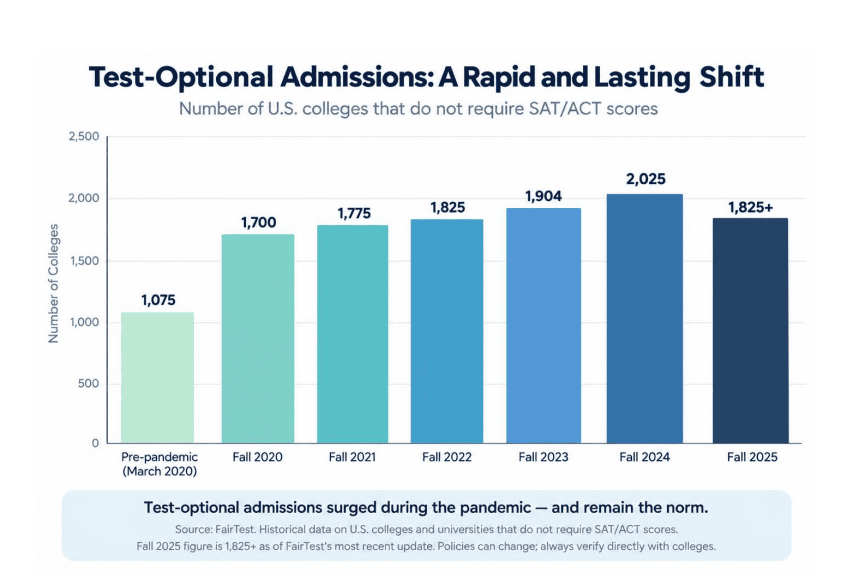
While the shift to test-optional was fast and furious, the post-pandemic landscape is evolving more slowly. College admissions policies didn’t simply return to their pre-pandemic norms
First, What Do All These Testing Terms Mean?
There are a few key terms you’re likely to hear during the college admissions process. It helps to understand each one and how they differ from one another.
1 Test-required: Applicants must submit standardized test scores as part of the admissions process.
2 Test-optional: Applicants decide whether to submit SAT or ACT scores. If they submit them, the college can consider those scores when evaluating the application.
3 Test-free or test-blind: SAT and ACT scores are not considered for admission, even if a student has them.
4 Test-flexible: A college allows applicants to satisfy testing requirements in multiple ways. Depending on the institution, alternatives might include AP or IB exam scores.
Of these terms, the two that cause the most confusion are test-optional and test-blind. At a testoptional college, your student doesn’t have to provide a score. However, if they do, that score can still become part of their application.
Where Do Test-Optional Colleges Stand in 2026?
Despite headlines about prominent universities reinstating testing requirements, test-optional admissions are still very common.
FairTest currently tracks 2,182 colleges with verified policies for the 2026–27 application cycle, generally covering students applying for fall 2027 enrollment. Of those, 84.7% are test-optional, 3.5% are test-free and 6.9% require scores. Policies for another 4.9% had not yet been confirmed.
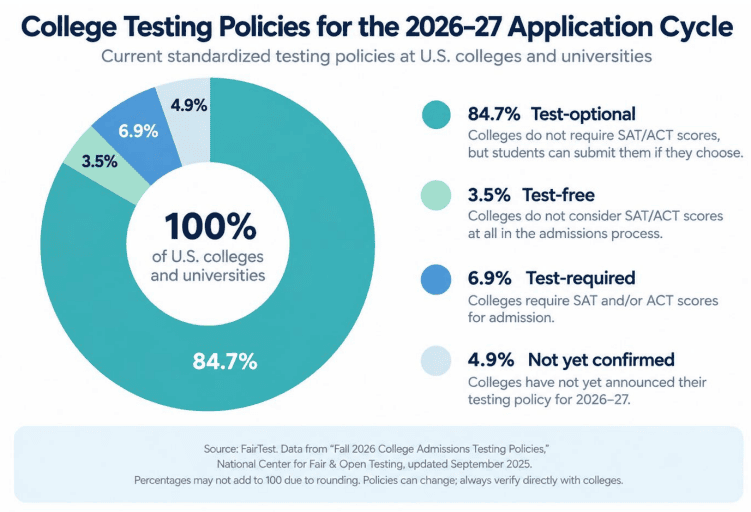
But those numbers don’t tell the complete story. While admissions departments may not be requiring scores, students are starting to submit scores more often. Common App reported a 12% increase in applicants reporting test scores during the 2024–25 application season. This was a clear reversal of the trend seen the previous two years.
There may be a strategic reason for the shift. At a test-optional college, a strong score can provide another piece of evidence that a student is academically prepared. This can be especially helpful in a competitive applicant pool.
That may shift your dinnertime discussion about college applications from “Do I have to submit a test score?” to “Would this score make my application stronger?”
As anyone who has ever prepped for the verbal SAT knows, words matter. “Optional” is not a synonym for “irrelevant.” At a test-optional college, a strong SAT or ACT score can still add useful information to a student’s application.
What If Your Child Plans to Attend a California University?
For families in Los Angeles, California adds another layer to the conversation.
The University of California and California State University systems currently do not use SAT or ACT scores to determine undergraduate admission. That means students applying to schools such as UCLA, UC Berkeley or CSU campuses do not need an SAT or ACT score for admission. CSU can, however, use scores after acceptance as one measure for math and written communication course placement.
But private California universities establish their own policies, so a student’s college list can contain completely different testing requirements.
Admissions requirements can change from one application cycle to the next, but if a UC campus is on your student’s “dream school” list, keep an even closer eye on testing policy. In 2026, the university began a new review of standardized testing in undergraduate admissions. Nothing is changing for students applying for fall 2027, but UC says no decision has been made yet about fall 2028 or future admissions cycles.
For parents of freshmen, sophomores and juniors in LAUSD, SMMUSD, CCUSD, MBUSD, or local private schools, that’s an important reminder: don’t build your student’s college plan around what the rules were for an older sibling or even what they are today.
Should Your Junior Still Take the SAT or ACT?
For many students, taking the test at least once may preserve options, provide peace of mind, or function as a safety net. A junior can take a test, see how they perform and later decide whether that score strengthens their application at each individual college. Skipping testing altogether removes that option and could limit a student’s choices if a school on their list changes its testing policy.
At Tutor Doctor Los Angeles, we suggest creating an initial college list and researching each institution’s current policy. Then consider having your student take a diagnostic SAT or ACT. (For more on why timing matters, see our related post on whether your student should still prep for the SAT even if it’s optional.) Those results can tell you far more than simply whether a student has a “good” or “bad” score.
Dig into the data to find out where they are actually losing points. Don’t panic! If they need additional support in algebra, grammar, reading efficiency, or a particular type of question, you have time to strengthen their skills in those key areas.
This is where personalized SAT tutoring, ACT tutoring, and one-to-one tutoring can be particularly valuable. Effective test prep shouldn’t mean indiscriminately completing hundreds of practice questions. We can review your student’s test results with you and identify specific academic or testing gaps. That allows our team to hand-pick a tutor whose strengths align with the areas where your student needs support. Focused, expert preparation helps students spend their limited study time where it can make the greatest difference.
Don’t Let Published SAT Ranges Scare You
Remember earlier when we said, “If only it were that simple”? Well, there’s another intricacy with test-optional admissions that applicants should understand.
At a test-optional college, published SAT and ACT ranges reflect the students who submitted scores. That is not necessarily representative of every student who was admitted. Students with stronger scores have an obvious incentive to submit them, while students with weaker scores are more likely to withhold them.
So if your student’s SAT score falls slightly below a college’s published range, don’t automatically conclude that the score is poor or that it shouldn’t be submitted. Instead, consider the entire application: GPA, course rigor, intended major, extracurriculars, the competitiveness of the institution, and how the score compares with the rest of the student’s academic record.
And remember that admissions aren’t necessarily the only reason test scores may matter. Depending on the college, program, or scholarship, SAT or ACT scores may still be considered for scholarships, honors programs, placement, or other opportunities. Always check how a school uses scores beyond its general admissions policy.
What Parents of Juniors and Seniors Can Do Now
For juniors here in Los Angeles, now is the time to build a preliminary college list, verify testing policies and establish a baseline SAT or ACT score. If improvement could meaningfully strengthen your student’s options, create a targeted preparation plan rather than waiting until application deadlines are looming.
For seniors, time matters more. Review the current policy at every school on the application list, including scholarship and program-specific requirements. Then make intentional decisions about where existing scores help the application and where withholding them may make more sense.
For students balancing AP classes, extracurriculars and college planning, adding test preparation to an already packed schedule can feel overwhelming. Personalized tutoring can help students focus limited study time on the skills that actually need attention rather than spending hours reviewing material they already understand.
The Bottom Line: Optional Means You Have a Choice
The pandemic transformed standardized testing in college admissions, but it didn’t make the SAT or ACT irrelevant. Your student may choose to submit scores to one college and withhold them from another. Their dream school may require them. And if you have a younger high school student, some of those policies could change before application season arrives.
The goal is to understand your student’s options before closing any doors and help them build the skills and confidence they’ll need for whatever comes next.
So, What’s the Right Next Step for Your Student?
At Tutor Doctor Los Angeles, we start by getting to know your student – their needs, goals, interests, personality, and learning style – and then personally match them with a tutor who can provide individualized one-to-one support. Whether your child needs to close a few gaps, rebuild confidence, or tackle more challenging material, the goal is never a one-size-fits-all program. It’s finding the approach that works for them.
Learn more about our personalized tutoring services, including Los Angeles SAT tutoring and ACT test prep, and book a consultation on our website and follow Tutor Doctor Los Angeles on Facebook and Instagram for practical tips, educational insights, and helpful guidance for supporting your child both in and out of the classroom.


