

If your child feels overwhelmed by SAT prep materials, you’re not alone. The SAT Reading and Writing section can seem like it tests every grammar rule in the book. The good news is that it doesn’t.
The SAT actually focuses on a predictable set of grammar and punctuation concepts that appear on every test. Once your child knows what to look for, the section becomes much less intimidating and they can approach it with confidence.
This guide breaks down the essential rules, provides examples to build skills, and offers a simple checklist for review. Whether your child is just starting their SAT prep or aiming for a higher score, understanding these concepts is the first step toward feeling prepared.
What Grammar Rules Does the SAT Actually Test?
The SAT Reading and Writing section asks students to act as an editor. They will read short passages and answer questions that require them to fix errors, improve sentences, and choose the clearest way to express an idea.
The encouraging part is that the test focuses on core concepts, not obscure rules. By mastering these patterns, students can learn to spot errors quickly and efficiently.
The SAT isn’t testing every grammar rule ever invented. It tests the same core concepts again and again, making it one of the most learnable sections of the test.
Core SAT Grammar and Punctuation Rules
Punctuation and grammar questions make up a significant portion of the SAT Reading and Writing section. By focusing on the rules that show up most often, your child can gain points and confidence.
Commas, Semicolons, and Colons
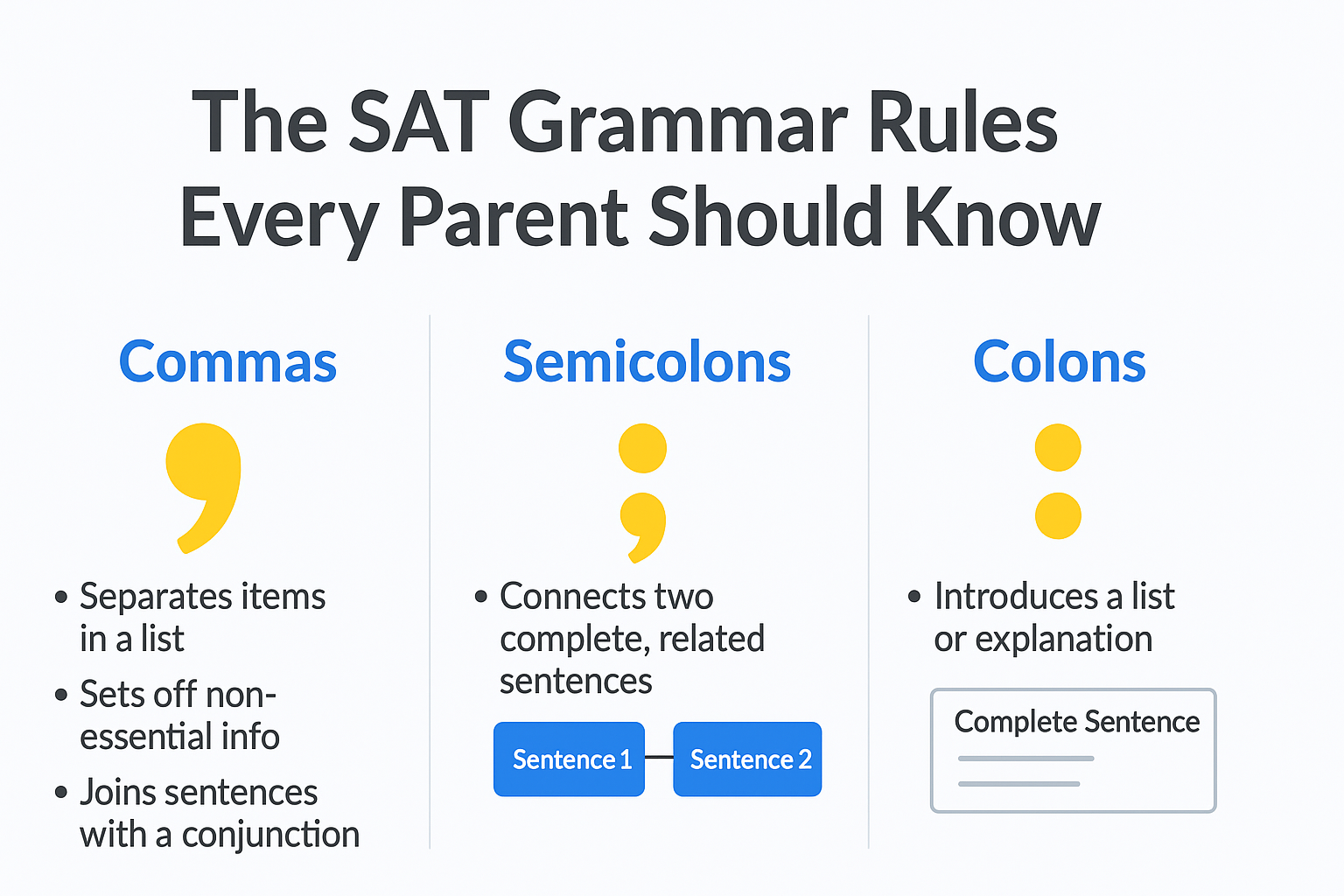
These three punctuation marks are frequently tested together. Understanding their distinct jobs is key.
Commas
Commas are the most versatile punctuation on the test. They are used to separate three or more items in a list, join two complete sentences with a coordinating conjunction (like for, and, but, or so), and set off non-essential information—phrases that can be removed without changing the sentence’s core meaning. Commas also follow introductory elements, such as “After finishing her homework, she watched TV.” A common mistake is placing a comma between a subject and its verb, which should be avoided.
Semicolons
Semicolons have one primary function on the SAT: to connect two closely related, complete sentences. Think of a semicolon as a lighter version of a period. Both sides of the semicolon must be able to stand alone as a full sentence.
Colons
Colons are used to introduce a list, explanation, or example that follows a complete sentence. The key is that the clause before the colon must be a complete thought. For example, “The plan had one goal: to increase student engagement.”
Dashes and Apostrophes
Dashes and apostrophes have specific jobs related to emphasis and ownership.
Dashes
Dashes are used to set off information with more emphasis than commas or to create a dramatic pause. For example, “The discovery—made entirely by accident—changed everything.” Paired dashes function similarly to paired commas for non-essential information but add a stronger sense of interruption or importance.
Apostrophes
Apostrophes are used to show possession (the student’s book) and to form contractions (it’s for “it is”). The most commonly tested apostrophe rule involves possessive pronouns. Words like its, your, their, and whose show ownership and never use an apostrophe. In contrast, it’s, you’re, they’re, and who’s are contractions.
Agreement and Consistency
Many SAT questions test whether different parts of a sentence logically agree with each other.
Subject-Verb Agreement
A singular subject needs a singular verb, and a plural subject needs a plural verb. The SAT often tries to distract test-takers by inserting a prepositional phrase between the subject and the verb. The key is to identify the true subject of the sentence. For instance, in the sentence “The box of assorted chocolates is on the table,” the subject is the singular “box,” not the plural “chocolates.”
The SAT often hides the sentence’s true subject. Learning to cross out the distracting phrase between the subject and verb is the key to solving most agreement questions.
Pronoun Agreement and Clarity
A pronoun must agree in number with the noun it refers to (its antecedent). For example, “Each student should bring his or her book.” The pronoun must also be clear. In the sentence, “When Sarah gave her mom the gift, she was happy,” it’s unclear who “she” refers to. A clearer version would be, “Sarah’s mom was happy when Sarah gave her the gift.”
Verb Tense
Verbs should remain in a consistent tense unless there is a clear reason to shift in time. If a sentence starts in the past tense, it should generally stay in the past tense. Context clues like “last year” or “since 2010” signal which tense is appropriate (simple past vs. present perfect).
Sentence Structure and Clarity
A clear sentence is a correct sentence on the SAT. These rules focus on logical structure.
Modifier Placement
A modifier is a descriptive word or phrase that should be placed directly next to the noun it is describing. A common error is a dangling modifier, which often appears at the beginning of a sentence. For example, “Running down the street, the bus almost hit me” incorrectly implies the bus was running. The correct version is, “Running down the street, I was almost hit by the bus.”
Parallel Structure
Items in a list or comparison should have the same grammatical form. For instance, instead of “She enjoys swimming, to run, and biking,” the parallel structure would be “She enjoys swimming, running, and biking.” This rule also applies to pairs like “not only…but also” and “either…or.”
Sentence Fragments and Run-Ons
Every sentence must have a subject, a verb, and express a complete thought. A sentence missing one of these is a fragment. Conversely, a run-on sentence incorrectly joins two complete sentences without proper punctuation (like a period or semicolon) or a connecting word.
Word Choice and Precision
The SAT rewards clear and concise language.
Commonly Confused Words
The test often includes words that sound alike but have different meanings. Knowing the difference is essential for earning points.
| Word Pair | Meaning & Use |
| Affect vs. Effect | “Affect” is a verb (to influence). “Effect” is a noun (a result). |
| Than vs. Then | “Than” is used for comparisons. “Then” refers to time. |
| Their/There/They’re | “Their” is possessive. “There” is a place. “They’re” means “they are.” |
| Whose vs. Who’s | “Whose” is possessive. “Who’s” means “who is” or “who has.” |
Conciseness and Redundancy
Often, the shortest grammatically correct answer is the right one. The SAT wants students to eliminate redundant phrases like “past history” (history is always in the past) or wordy constructions like “due to the fact that” (which can be replaced with “because”).
How to Practice These Rules Effectively
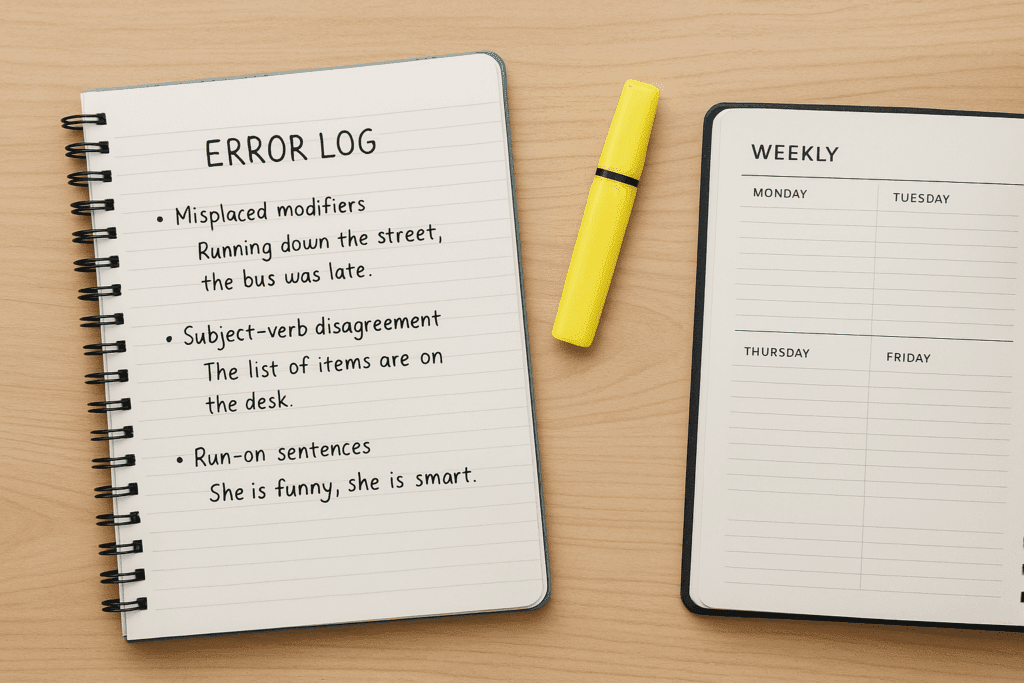
Knowing the rules is the first step; applying them under pressure is the next. Here’s how your child can practice in a way that builds lasting confidence:
Focus on Understanding, Not Speed
When first learning, it’s more important to understand why a rule works than to rush through questions. That deep understanding is what helps on test day.
Look for Patterns
Encourage your child to keep a simple error log. An organized approach, even one using a planner that works for them, can help them spot recurring mistakes and focus their practice.
Use Official Practice Materials
The College Board provides official practice tests that mirror the format and difficulty of the real SAT. Using these materials helps students know what to expect.
Learn from Every Mistake
When reviewing, it’s helpful to understand why a certain mistake was made. This helps students recognize and avoid common traps in the future.
For more ideas, explore our guide to creating a positive study environment that supports focus and learning.
Progress isn’t just about speed; it’s about understanding. When your child can explain why an answer is correct, they are building a skill they can apply to any question.
Building Confidence with the Right Support
It’s normal for some grammar rules to feel more challenging than others. Often, a concept that’s confusing in a prep book can click into place when explained in a way that matches your child’s unique learning style.
This is where personalized support makes all the difference. Our tutors help students build the skills and confidence needed to turn a tricky section into an opportunity to gain points. With the right guidance, your child can walk into test day feeling capable and prepared.
Ready to help your child build confidence for the SAT? We make learning personal. Find a tutor near you to get started.