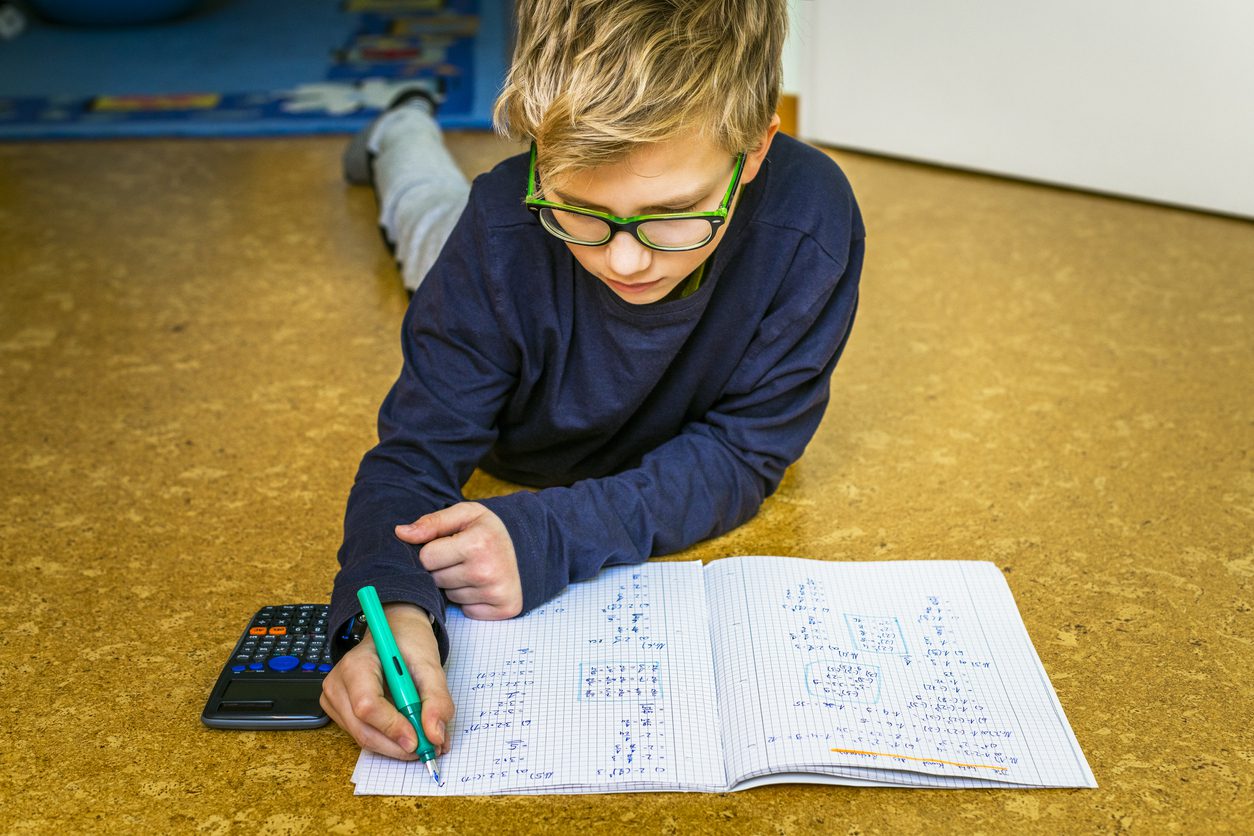

Your child sits down with their maths folder. They read through a page of worked examples, highlight a few lines, and close the folder feeling like they have revised. Two weeks later the same topic comes up in a mock paper and they cannot even start the question.
If that sounds familiar, it is not laziness and it is not a lack of ability. It is that maths does not respond to the revision method most students are taught, and nobody has shown them the alternative.
What follows is the approach a good maths tutor takes, broken down so you can start some of it at home tonight. It is also a fair description of what you are paying for if you decide one-to-one support is the right step.
Why maths revision needs its own method
For History or Biology, revision is largely about getting information into your head and being able to get it back out again. Notes, flashcards and mind maps suit that job well.
Maths is different. Knowing the method is only half of it. Your child also has to execute it, on their own, at speed, on a question phrased in a way they have never seen before. The gap between “I understand it when my teacher does it” and “I can do it under timed conditions” is where most marks quietly disappear.
So the working rule is this: if your child has not put pen to paper and produced an answer, they have not revised. Watching a video is preparation for revision, not revision itself. Our general guidance on revising effectively in the final weeks before exams applies to maths too, but the emphasis on active practice matters far more here than in any other subject.
Step one: diagnose before you teach

The first thing a maths tutor does is not teach. It is find out where the problem actually starts.
This matters because maths compounds. A student struggling with algebraic fractions in Year 11 is very often a student who never quite secured ordinary fractions in Year 6. Reteaching Year 11 content to that student will not work, however patiently it is done. The gap has to be found and closed first.
In a first session, a tutor will usually work through a short diagnostic set, watch how your child approaches each question rather than just whether they get it right, and trace the errors back to their source. That is the part a busy classroom teacher with thirty students genuinely cannot do.
At home, you can make a start on the same thing. Take the topic checklist from your child’s exam board specification, whether that is AQA, Edexcel or OCR, and ask them to mark every topic red, amber or green, honestly. Then revise the red list first. Mock papers are the other diagnostic worth using properly: a mock is not a verdict, it is a map. Our guide to when to start revising for GCSEs sets out a realistic timeline from there.
Step two: practise with someone watching the working
Once the gaps are known, the work is practice. But there is a specific reason one-to-one practice beats solo practice in maths, and it is not motivation.
When your child works through a question alone and gets it wrong, they find out that they got it wrong. When they work through it next to a tutor, the tutor sees the exact line where the method broke down, often several steps before the wrong answer appeared. That is a completely different piece of information, and it is what makes the next twenty minutes useful rather than repetitive.
Little and often works better than long sessions, because maths skills fade fast when they are not used. For a Year 10 or Year 11 student, twenty to thirty minutes on most days will do more than three hours every other Sunday.
A realistic week for a Year 11 student
- Monday to Thursday: 25 minutes on one red topic, ending with three exam-style questions on it.
- One tutoring session, used for the topics that did not go well and for anything they could not unpick alone.
- Saturday: one full section of a past paper under timed conditions.
- Sunday: off, or a short mark-scheme review of Saturday’s work.
Step three: mark the method, not the answer
This is the single change that moves marks fastest, and almost no student does it without being shown.
GCSE and A-Level maths papers award method marks. A student can reach the wrong final answer and still collect most of the marks available if their working is clear and their method is sound. Equally, a student can write a correct answer with no working and lose marks they had genuinely earned.
So when a practice question is checked, the question is not “right or wrong”. It is “where were the marks allocated, and would my working have picked them up?” Tutors spend a surprising amount of time on this, because exam technique is often worth more to a borderline student than any additional content.
It also helps to keep a running error log: one page listing every mistake with a single line on what went wrong. Patterns appear quickly. Most students are not making a hundred different errors, they are making four errors twenty-five times each.
Step four: rehearse under real exam conditions
Two things catch students out on the day, and both are fixable well in advance.
The first is the non-calculator paper. Students who revise entirely with a calculator to hand get a genuine shock in Paper 1. Long multiplication, division, fractions and surds all need rehearsing by hand, and that rehearsal should start long before study leave.
The second is timing. On a typical GCSE maths paper, students have around ninety minutes for eighty marks, which is roughly a minute per mark. Practising with a clock running turns that into instinct, so your child is not still labouring over a three-mark question ten minutes in.
For A-Level students, where papers are longer and the content more abstract, the same principles hold with more structure behind them. We have covered that separately in our post on effective study techniques for A-Level success.
What one-to-one maths tuition adds
A good maths tutor is not there to reteach the syllabus from the beginning. They are there to do four things a classroom cannot easily do:
- Find the specific gap causing the problem, even when it sits two or three years back.
- Watch the working in real time and correct the method at the point it breaks.
- Adjust pace and explanation to how your child actually thinks, rather than to a class average.
- Rebuild confidence, which in maths is very often the thing holding the marks down.
Matching matters as much as subject expertise here. A tutor who knows the specification inside out but cannot build a rapport with a discouraged fifteen year old will not get very far. That is why we match every student deliberately rather than algorithmically, and why you can read about how our tutors are selected and vetted before you commit to anything.
You also get a session report after every lesson, so you know what was covered and what is next, plus a local team who check in with you rather than leaving you to guess how it is going.
“She went from ‘maths is hard’ to ‘I’m really good at maths!’, as well as learning some exam techniques to calm her nerves.”
Signs your child would benefit from a maths tutor
Not every wobble needs a tutor. These are the patterns that usually do:
- They can follow the lesson in class but cannot start the homework on their own.
- Marks are drifting down across a term rather than dipping once.
- They are avoiding maths homework specifically, while coping with other subjects.
- Mock results came in well below their target grade and nobody is sure why.
- They have started saying “I am just not a maths person”.
That last one deserves attention. Maths anxiety is well documented and more common than most parents realise, and pushing harder tends to make it worse. What helps is lowering the stakes: opening every session with two or three questions your child can definitely do, praising the working rather than the answer, and avoiding “I was terrible at maths too”, however kindly it is meant. We have written more on this in 7 strategies to boost confidence in maths students. For younger children, maths apps can take some of the pressure out of practice.
What maths tuition costs, and how much is enough
Rates vary by area, by level and by whether sessions are in your home or online, so the honest answer is that your local team will give you an exact figure at the consultation rather than a range that turns out not to apply to you.
The more useful question is usually how many sessions it takes to see something change. In our experience a focused block of eight to ten sessions is often enough for a parent to notice a difference, particularly when the diagnostic work in step one has been done properly and the sessions are aimed at the right topics. Between mocks and final exams we regularly see students move up by one to two grades with a clear plan and consistent work, although no tutor can promise a particular grade.
It is worth framing the cost against what the grade unlocks, whether that is a sixth form place, a college course or a specific A-Level. If the exam has already gone, that is not the end of it either: maths resits run in November, and our guide to resitting English and Maths GCSEs walks through the options.
Frequently asked questions
How long should my child revise maths for each day?
For Year 10 and Year 11, twenty to thirty minutes on most days is a sensible target outside the final run-up, rising over the Easter holidays and study leave. Consistency matters more than volume, because maths skills fade quickly when they are not used.
Is it too late to get a tutor before the exam?
Rarely. Because maths marks concentrate in specific topics and question types, targeted work can shift a grade in a way that is harder in essay subjects. What matters is that the remaining time goes on the right topics rather than the comfortable ones, which is exactly what a diagnostic first session is for.
Online or in person for maths?
Both work. Online suits older students and families with tight schedules, and shared digital whiteboards handle working out well. In-home sessions often suit younger children and those who find it easier to focus with someone in the room. We offer both, so you can pick what fits.
My child says they are “not a maths person”. What should I say?
Try something more accurate: they have not yet been taught this particular thing in a way that works for them. That is a solvable problem, and it is usually true. Avoid agreeing with the label, even sympathetically.
Are past papers enough on their own?
They are the most valuable single tool, but only alongside the mark scheme. A past paper completed and never properly marked tells your child what they cannot do without telling them why, which is discouraging rather than useful.
Talk to us about maths
If maths is causing stress at home, we are happy to talk it through with no obligation. Book a free consultation and we will look at where your child is now, what is realistic in the time available, and whether one-to-one support is the right next step. You can read more about our maths tutoring and our GCSE maths tutors, see what other families have said in our parent reviews, or find your local Tutor Doctor team.